
How to Tell Real Pearls from Fake
Six simple tests you can do at home — plus the one thing almost everyone gets wrong about "real" pearls.
Before we get to the tests, there's something you should know — because it changes everything:
Almost every pearl sold today is a "cultured" pearl — and cultured pearls are real pearls. They are made of the same material, by the same organic process, as pearls found in the wild. The real question isn't natural versus cultured. It's real nacre versus fake coating.
What "real" actually means
There are three things people call pearls. Only the first two are real:
Natural pearls
Formed when an irritant enters a wild mollusc, which coats it in nacre as a defence. Extraordinarily rare — almost never found on the commercial market. If you own one, it's a museum piece.
Cultured pearls
The same biological process, but started by a technician who implants a small nucleus into the oyster. The oyster then layers nacre around it, exactly as it would in the wild. These are genuine pearls — and they make up over 99% of all pearls sold today, including every pearl at YI+ Jewelry.
Imitation pearls
Glass, plastic, or shell beads coated with a luminous paint. They contain no nacre at all. Cheap to make, easy to spot once you know how.
Six tests you can do right now
None of these require equipment. Together, they'll tell you what you're holding.
The tooth test
Gently rub the pearl along the edge of your front teeth. A real pearl feels slightly gritty or sandy, because of its layered nacre. An imitation — especially plastic — feels smooth and glassy.
The temperature test
Pick up the pearl. Real pearls feel cool at first, then warm up quickly against your skin. Plastic and resin imitations feel room temperature the moment you touch them.
The weight test
Hold the strand in your palm. Genuine pearls are dense and feel noticeably weighty and solid. Imitations feel light and hollow by comparison. (Some high-end fakes get close — but most fail here.)
The surface test
Look closely. Real pearls are organic and rarely perfectly uniform — you'll see small ridges, dimples, and slight differences in shape and size from pearl to pearl. A strand where every pearl is identical in size, colour and sheen is suspicious — real pearls don't come that way.
The luster test
Hold the pearl up to the light and slowly rotate it. Real pearls give a soft, layered, deep glow — the trade calls it "orient." Imitations look flat or overly shiny, like a mirror or a painted bead.
The drill hole test
Look at where the thread passes through. Real pearls have small, clean, precise holes. On imitations you'll often see chipped or peeling coating around the hole — the paint flaking off reveals the bead underneath.
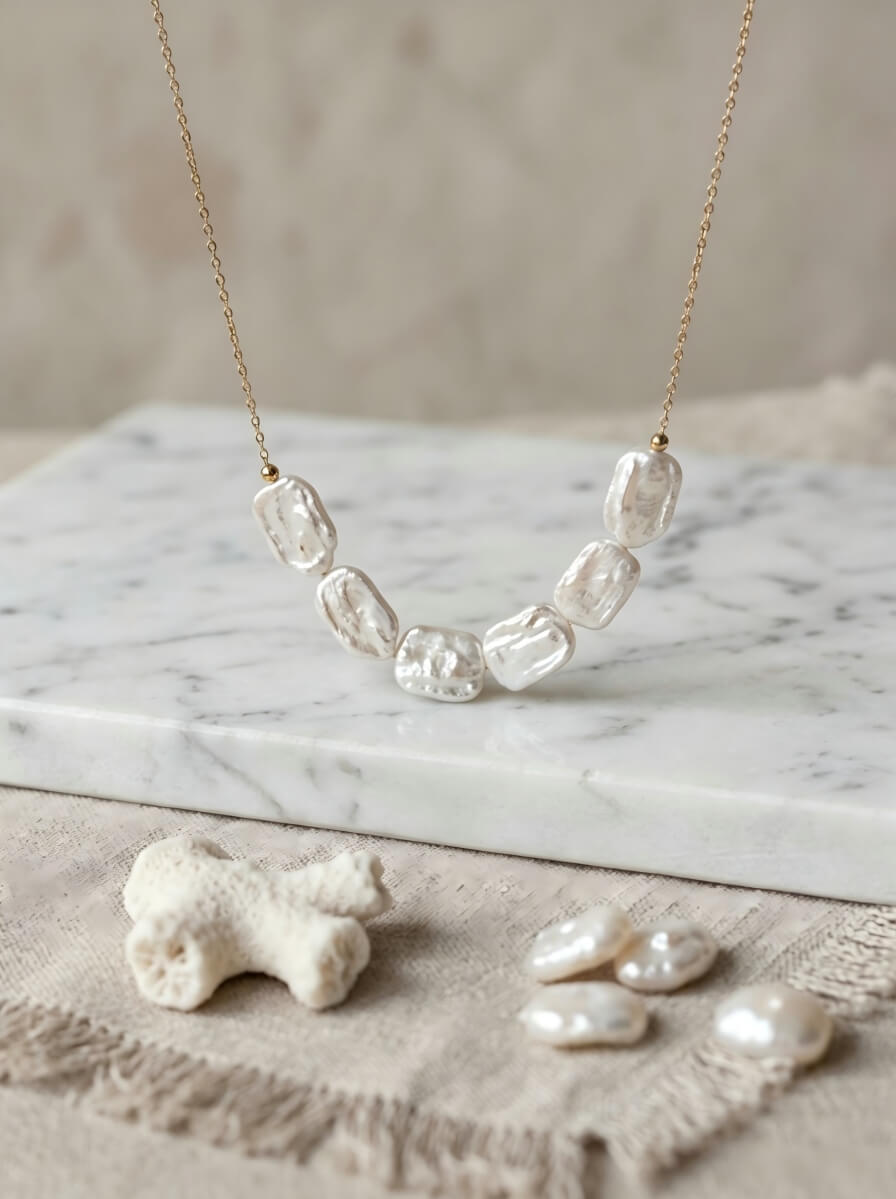
Why baroque pearls are a good sign
If you see the word "baroque" — or pearls that are irregular, oval, or organically-shaped rather than perfectly round — that's usually a mark of authenticity, not a flaw.
Perfectly round pearls are rare and expensive. Imitations are made round because a round mould is easy to produce. A real freshwater pearl's natural shape is part of its character.
Real vs fake, side by side
| What to check | Real pearl | Imitation |
|---|---|---|
| Against teeth | Gritty, sandy | Smooth, glassy |
| Temperature | Cool, then warms | Room temp at once |
| Weight | Weighty, solid | Light, hollow |
| Surface | Small natural variations | Perfectly identical |
| Luster | Soft, deep, layered | Flat or glassy shine |
| Drill hole | Clean and precise | Coating may flake |
| Shape | Often irregular / baroque | Uniform, mould-made |
Four myths to ignore
What's in a YI+ Jewelry piece
Every YI+ Jewelry necklace, bracelet and earring is made with genuine cultured freshwater pearls — the real thing, grown by the same organic process as natural pearls, then hand-selected and hand-strung in our studio.
- Real nacre — each pearl is coated in layer upon layer of genuine nacre, which is what gives it depth and glow.
- Natural baroque shapes — many of our pearls are deliberately irregular. That's a hallmark of real freshwater pearls, not a defect.
- Hand-strung and knotted — quality stringing protects your pearls and keeps them secure.
Frequently asked questions
Are cultured pearls real pearls?
Yes. Cultured pearls are real pearls. They form through the same biological process as natural pearls — the oyster coats an irritant in layers of nacre — the only difference is that a technician starts the process. Over 99% of pearls sold today are cultured, including all pearls at YI+ Jewelry. "Cultured" means farmed, not fake.
Do real pearls feel gritty on your teeth?
Yes. A genuine pearl feels slightly gritty or sandy when gently rubbed against the edge of your front teeth, because of its layered nacre surface. Imitation pearls, especially plastic ones, feel smooth and glassy. Do this gently, and avoid doing it on pearls you don't yet own.
How can I tell if pearls are plastic?
Plastic pearls feel warm or room-temperature immediately, are noticeably lightweight, and feel perfectly smooth in the tooth test. They also usually look flatly shiny rather than softly glowing, and may show peeling coating around the drill holes.
Are freshwater pearls real pearls?
Yes. Freshwater pearls are genuine pearls grown in freshwater mussels. They are usually more irregular in shape than saltwater pearls — an organic, baroque character that many people prefer. YI+ Jewelry uses genuine cultured freshwater pearls.
Can a jeweller tell for certain if pearls are real?
Yes — professional assessment is the most reliable method. A gemmologist can examine the nacre layers under magnification and use X-ray or other instruments to confirm authenticity with certainty. If a pearl matters to you, a professional evaluation is worth it.
Genuine pearls, hand-strung to last
Every piece is made with real cultured freshwater pearls and crafted by hand in our studio.
Shop the Collection